What Becomes Possible Because People Gather
Yesterday, I hit a wall.
Not a dramatic one. The quiet, foggy kind that comes from too much reporting, too many hours staring at a screen, and one tab too many.
So I did what I often do when my brain needs air. I gave myself a productive break. I opened a blank Google Sheet and started tracking attendance from our recent monthly gatherings.
At first, it was purely practical. I’m going to need this for reporting anyway.
Rows. Columns. Checkmarks.
Something finite. Contained. Calm.
Then something shifted.
I started noticing patterns.
Who had come once.
Who kept showing up.
And who… hadn’t made it at all.
That’s when it stopped being about documentation and started being about outreach.
If we can see who hasn’t been able to attend yet—or who came once and drifted—we can reach out not to nudge or persuade, but to understand.
Is the timing off?
Did something change?
Do they still feel connected?
And because I’m me, I couldn’t leave it there.
That small sheet made its way into a dashboard I’ve been building quietly in the background (one piece at a time) adding views that felt useful, not performative.
At a glance, you could now see:
- who hadn’t attended at all
- who came once
- who stayed
- and how participation shifted over time
What started as a brain break became a living view of rhythm, relationship, and care.
I shared a few screenshots with a simple note: I needed a break from heavy thinking — this helped.
What I didn’t say yet was that something bigger had started to take shape. Because once the data was visible, the questions changed. Not how do we get more people on calls?
But:
What does being on a call actually enable?
That question didn’t originate with me. It came back to me—reflected, sharpened—and it cracked something open. Because it reframed the entire exercise.
Attendance wasn’t the outcome.
Participation wasn’t the goal.
The real inquiry became:
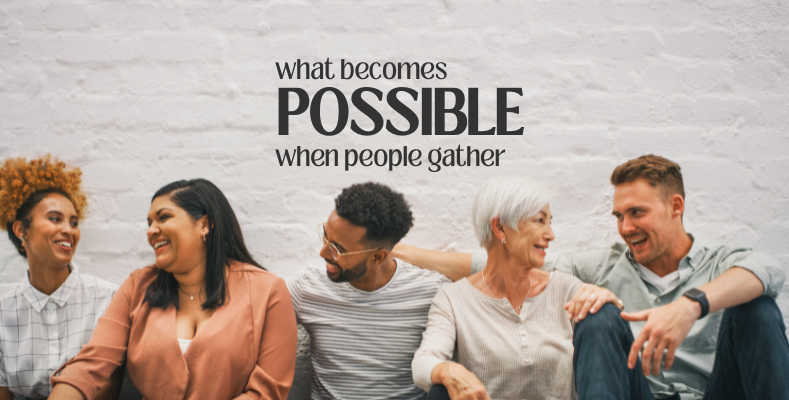
What becomes possible because people gather?
When I overlaid attendance with retreat sign-ups, a quiet pattern appeared.
People who had been in the room, who had felt the tone, the pace, the care, were far more likely to say yes to gathering in person later. Not because they were convinced. But because something had already happened inside the relationship.
That’s when it clicked. This isn’t attendance data.
It’s conditions.
Conditions for trust.
For calm.
For new connections to form sideways, not top-down.
For people to feel resourced enough to step forward.
That question—what does this enable?—sent me exploring in an entirely new direction. Toward a different kind of dashboard. One that isn’t just internal or operational, but public-facing.
Not to persuade.Not to optimize behaviour. But to help people see what we’re seeing.
To make the invisible visible:
- the way presence changes tone
- how connection compounds over time
- what participation quietly enables downstream
That same afternoon, while all of this was still half-formed, I went for a walk. And right in the middle of that walk, my phone rang. Someone calling from another country. Walking too. Offering encouragement, reflection, and a simple reminder: Keep exploring. You don’t need to land it yet. Two people moving through different places, talking about curiosity, emergence, and letting ideas reveal themselves in their own time.
It felt oddly perfect.
Because this whole thing—the sheet, the dashboards, the questions—didn’t come from sitting still and forcing clarity.
It came from motion.
From walking.
From pausing.
From letting the body lead the thinking for a moment.
Which feels important.
Because what I’m actually interested in isn’t tracking participation.It’s noticing how insight appears when we’re not trying to extract anything. How the most useful systems don’t shout instructions—they whisper invitations.
How care, when visualized gently, doesn’t pressure people to perform, it gives them something to lean into.
So for now, I’m letting it percolate. Letting other eyes look. Letting the shape reveal itself instead of naming it too quickly.
Because sometimes the work isn’t to finish the thing. It’s to recognize when you’re standing at the edge of something new and choose to stay curious a little longer.